
Building assets with subsidized tokens.
It's been three and a half months since I started using Claude Code in my daily work. As I got better at putting it to work, my usage changed dramatically. Sixty-eight percent of every token I've burned since February came in the last month alone. This isn't a survey or a hot take. It's what I lived, backed by my own logs and receipts.
Here's the short version. Over those three and a half months, Claude Code and I did the work we'd scoped for a small team of developers to do over the better part of a year. The inference cost me under $600.
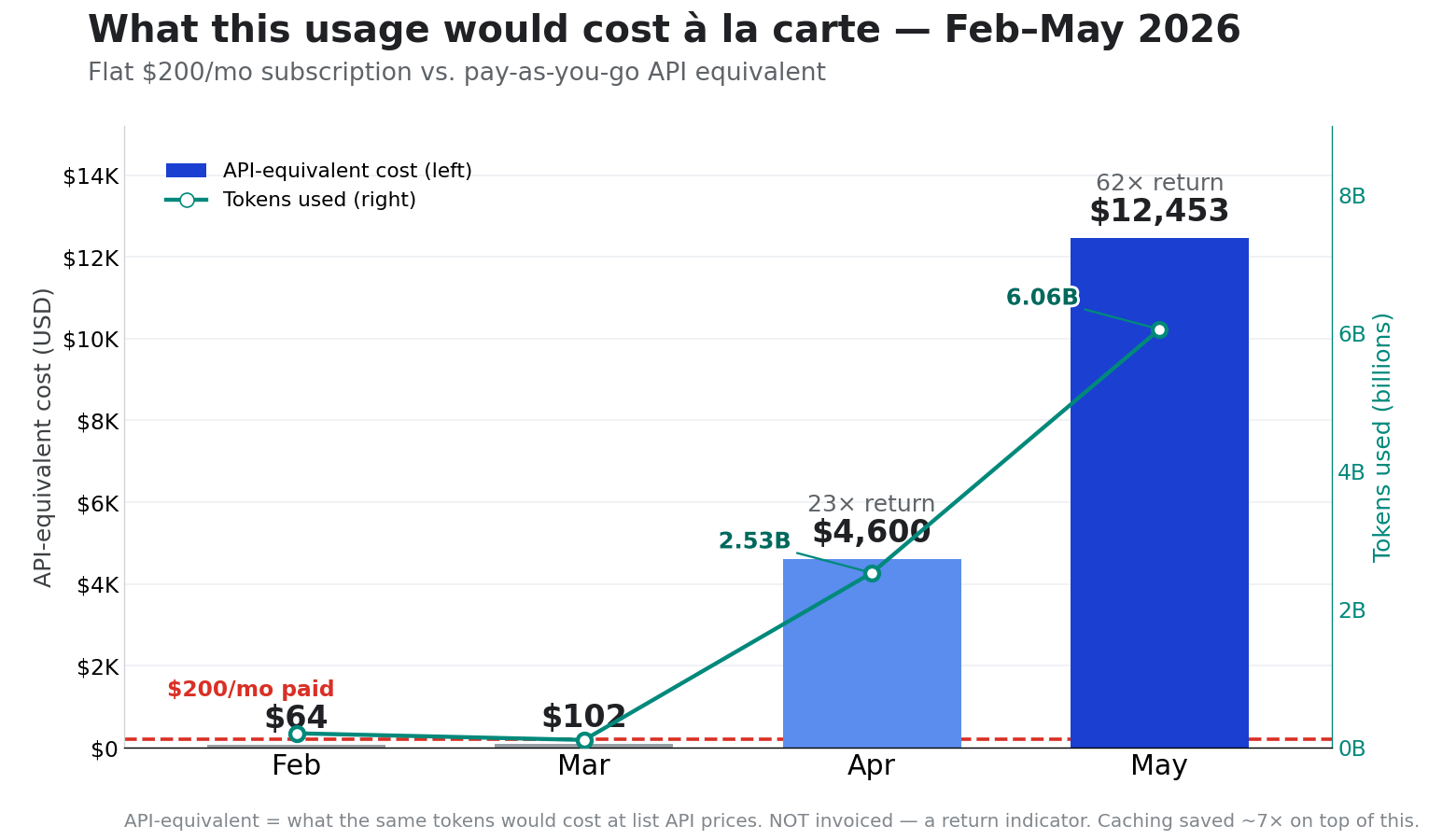
What my usage would have cost à la carte on the API, month by month, against the flat $200/mo I actually paid.
Sit with that number for a second, because the rest of this is about what it actually means: why it's a worse deal than it looks, and a better opportunity than almost anyone realizes.
The value is real
I worked on around a dozen different projects, but the tokens went predominantly to two that have shipped and are generating real value today.
The first is a rebuild of one of our products — a legacy app that was, honestly, awful. Customers were churning off it, and they were right to. It's roughly 10% of our company's ARR, and it was shrinking. We had scoped a from-scratch rebuild as something like a year of work. Today, one quarter after I wrote the first prompt, it's live with industry-leading improvements in capability. Customers are noticing. One important client had already told us they were leaving; we saved the account and then grew it 2.35×. In the first week the rebuilt product was live, we saw a 6% bump in ARR from net-new customers. A declining liability is now a growth engine.
The second is internal: our company's HQ app, the thing our operations and go-to-market work now runs on. Best estimate, it's already replaced a full-time hire. But the replaced-headcount framing undersells the value, because it's a foundation. Every ops and GTM workflow we build from here sits on top of it. HQ's value is just getting started.
Two real assets. One bill. Let's dive into it.
The AI cost was just 4%
The people on YouTube arguing about the cost of AI coding are staring at the wrong line item. The tokens were not the expensive part — at least not right now.
Of everything it took to build these — my time plus the compute — the compute was about 4%. The other 96% was me: my hours, my judgment, my context on the business. That's the number that matters. AI is impressive, but without a deeply knowledgeable user guiding it, it's worthless. People obsess over token efficiency the way you'd obsess over the cost of the staples while ignoring the salary of the person using the stapler.
If I wasn't doing this work myself, the plan was to hire two developers for the better part of a year. The median U.S. software developer makes $133,080 a year, per the Bureau of Labor Statistics. Load that with benefits and overhead and we're in the $160K range. Two of them for three quarters is a quarter of a million dollars in cost, before you add a product manager's time.
I did the work in roughly 200 hours, squeezed around running two companies and re-launching another product in March and April, plus that $600 of compute. Run the division: every hour I personally put in offset somewhere north of a thousand dollars of developer payroll. That's the gap — what my time costs me on one side, what it just saved me on the other.
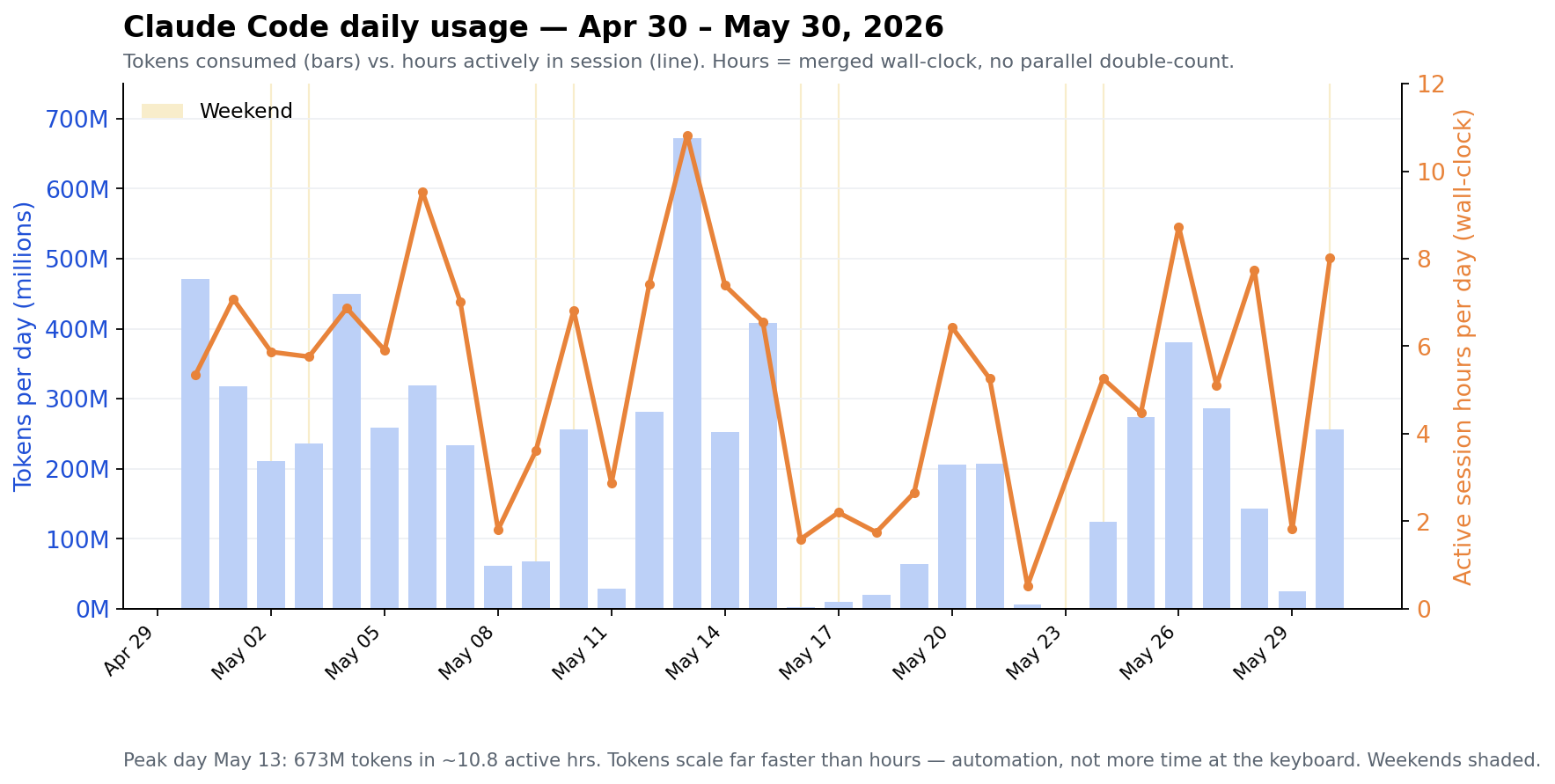
Daily token usage (bars) against hours actively in session (line). Peak: 673 million tokens on May 13, in under 11 active hours.
That's the genuinely new thing here. People say "AI is cheap" and stop there, but the real story is that your time, pointed at a coding agent, is worth multiples of what it was worth pointed at anything else. The agent didn't replace me. It replaced the two people I would have had to hire to stand between me and the work.
One more thing this exposes, because every lazy take about "AI cost" trips on it: tokens, time, effort, and output are four different things, and they do not track each other. Tokens are how hard the machine worked. Hours are how much of your life it took. Effort is the cognitive load. Lines of code are what shipped. My heaviest token month produced barely any code and ate the most of my hours — it was a hard thinking month, not a hard typing one. Anyone reasoning about this on a single axis is wrong before they start.
Price in the subsidy
I paid under $600 for around $250K of coding. That's an astonishingly good ROI. But it's not real or durable — it's propped up by three things.
First, the price itself. The price you pay for a token today is not a market price. It's a customer-acquisition price, paid for with someone else's losses. The venture capital pouring into these companies is covering a chunk of your token bill. The AI companies themselves are money furnaces — xAI posted a roughly $2.5 billion operating loss in a single quarter (Q1 2026, per SpaceX's IPO filing), and it is not alone in the basement.
Second, the flat plan. I pay $200 a month. In May, my heaviest month, I ran 6 billion tokens. At list API rates that comes to roughly $12,453. I paid $200. That's about 62× return on the subscription, in a single month — and I was never once throttled, not even on the day I burned 673 million tokens. Capacity was never my constraint, which is another way of saying the plan is wildly underpriced for how I'm using it.
Third, caching. Something like 95 to 97% of my tokens were cache reads — context the model had already seen, billed at a small fraction of the normal rate. That discount did most of the heavy lifting on the price. Strip it out and that same month would have cost nearly $88,000. And it's not a hypothetical I made up to scare you: change the caching rules, or spread your work across enough projects that the cache keeps going cold, and you pay full freight.
| Month | API-equivalent value | Subscription paid | Return |
|---|---|---|---|
| February | ~$64 | $20 | 3.2× |
| March | ~$102 | $100 | 1.0× |
| April | ~$4,600 | $200 | 23× |
| May | ~$12,453 | $200 | 62× |
Three subsidies, stacked: the furnace, the flat rate, the cache. The bargain everyone's celebrating exists because three different parties are eating the cost so I don't. It's a fantastic deal. But let's be honest about whose money is making it one.
Cold water for the doomers
Here's where it bites the pundits and fear-mongers writing the labor-apocalypse headlines.
When the furnaces decide to stop burning and start earning, the price goes up. If list API pricing is the better proxy for what an unsubsidized token actually costs, we're talking about something like a 60× move from where flat-subscription economics sit today.
This isn't speculation. It's already starting. On June 1, GitHub Copilot moved to fully usage-based billing — metered tokens instead of all-you-can-eat. GitHub said the flat model was "no longer sustainable," because a quick chat question and a multi-hour autonomous coding session were costing them the same flat fee and burning very different amounts of compute. You don't have to imagine the heavy user who breaks the all-you-can-eat math. I'm him. Six billion tokens in May, $12,453 of compute at list rates, $200 paid. Multiply my profile across every developer seat and the subscription model doesn't survive contact with a P&L.
So when someone tells you AI just made software labor worthless — that the developers are finished, the apocalypse is here — ask them what they're paying per inference token, and what it costs to build the model. They're quoting a subsidized price against a fully-loaded salary and calling it a law of nature. At true market cost, that doomer math gets dunked in a tank of cold water.
The capability is real, but the pricing is a promotion. Confusing the two is the mistake.
So build the asset
This is exactly why the moment is so exciting and valuable, and why most people are wasting it.
If the price of building is artificially low right now, the right response is to build things that keep paying after the price corrects. Owned software that generates real ARR. Internal systems that cut real cost and make the business work better. Go-to-market systems. Real customers migrated onto value-adding platforms you control. The two apps I described don't have a token meter running under them every time they earn. They were built with cheap tokens, and now they just run. That's an asset.
The opposite is a business whose unit economics only pencil at today's subsidized token price — a thin wrapper that buys an expensive API call every time a customer breathes. That's renting your margin from a landlord who is very obviously about to raise the rent.
We're living through one of those moments. Every big platform shift gets bankrolled the same way early on: investors eat the cost to buy your habit. Uber did it famously — for years we rode around town with VCs quietly covering half the fare. It was great. We saved ten bucks a trip. This is that, except the prize isn't a cheaper cab ride. With an agent and a $200 subscription, the discount isn't on what you consume. It's on what you can build.
So build. Use the cheap tokens to put up something that's still standing when the rent comes due — something you own, not something you have to keep feeding by the call.
Build the asset. Don't be the asset.
P.S. — I pulled these numbers with ccusage and adjusted for newer Opus model pricing, which its built-in price table doesn't yet cover. Fair warning: by default, Claude Code shreds those detailed logs after 30 days. When I went looking, most of my history was already gone — the only reason I could write this is that an old pull happened to survive in a buried transcript. If you ever want to slice and dice your own usage, change cleanupPeriodDays to something well above 30 today. I did.