Everyone's talking about buying a business from a boomer. The Silver Tsunami. Five trillion in enterprise value changing hands. Retiring owners with no succession plan. You've read Walker Diebel's bestselling how-to guide Buy Then Build. You've studied LOIs, talked to brokers, maybe even closed a deal. Congratulations — there's an entire industry built around getting you to the closing table. Almost nobody is talking about what happens next.
What does Monday morning look like when you're sitting in a business that was built and run out of one person's head for twenty years? The content drops off a cliff right after close. And that first year — not the search, not the diligence, not the financing — that first year of actually running it is the hardest part.
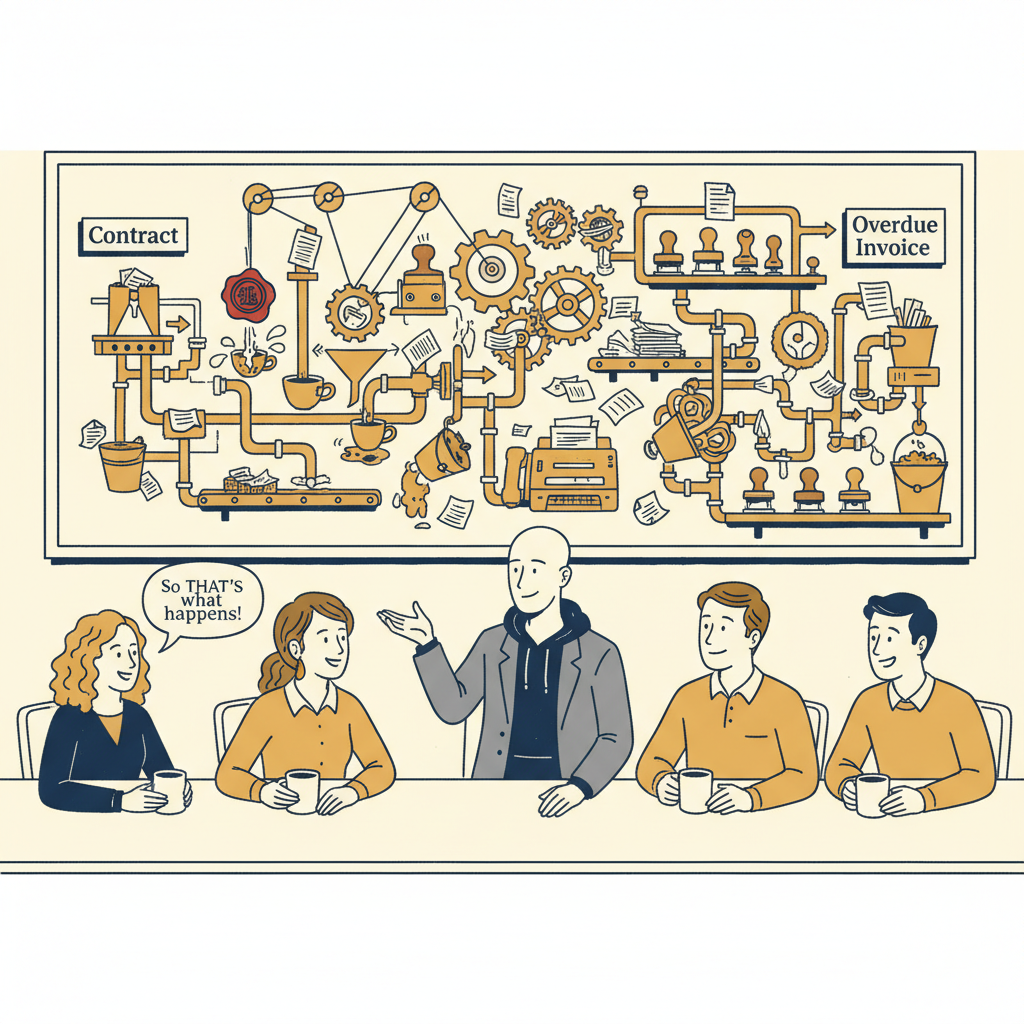
I took over a SaaS company last year where the biggest customer had churned twelve months prior, revenue was cratering, and every process was a Rube Goldberg machine. Even a $30-per-month contract required a five-step proposal-to-signature process and an overly complicated onboarding workflow that often stalled or failed entirely, leading to billing lapses. The company was closing a deal or two per month, but churn was eating the customer base faster.
The billing side was worse. Over twelve years the team had created nine different ways for customers to pay. A botched implementation of a new billing system left them manually trying to keep two systems of record in sync. It looked like $200K in unpaid invoices. Reality: about $115K in actual receivables and $85K of phantom money that never existed. No buyer would have survived the quality of earnings assessment. This business had been unsellable long before I showed up.
That's the part nobody warns you about. The seller built something that evolved over time, wasn't intentionally designed — held together by institutional memory, spreadsheets or stacks of paper, and one person who knows where everything lives. Now you need it to work for you. You need an operating system.
I'd been studying and implementing EOS — the Entrepreneurial Operating System, laid out in Gino Wickman's Traction — for five years before this deal. Ran my previous startup on a hybrid of it. Even my family runs on EOS. So when I walked into this mess, I didn't have to figure out how to get started. I already had the playbook.
If you're buying a business with over $2M in revenue and ten or more employees, don't spend five years learning this from trial and error like I did. Cut a check for speed and bring on an EOS implementer.
Walk In Like You Own It
Day one as the new owner is tough for everyone. The team is nervous. They don't know what you're going to change, who you're going to fire, whether their job is safe. You need to get ahold of that anxiety and channel it into something productive. The worst thing you can do is spend weeks "getting the lay of the land" while the team sits in limbo guessing what comes next. They're already bracing for impact. Rip the band-aid.
When I showed up, I didn't ask for a vote. I said hello, I'm Mike, my job is to turn this company around, and we're going to start running a weekly L10 — a Level 10 meeting, ninety minutes, same time every week, structured agenda designed for accountability and working real business issues through to resolution every week — today. Here's the vision. Here's where we're headed in three to five years. Let's go.
EOS gives you a tool for this called the VTO — the Vision/Traction Organizer. Two pages. Core values, core focus, ten-year target, three-year picture, one-year plan, quarterly Rocks. You either build that with the team or you walk in with it on day one. Either way, the team leaves that first meeting knowing where the company is headed. For a new owner that's not just a planning exercise — it's the first thing you do to prove you have a plan and their jobs have a future. Most of the team was relieved. They wanted structure. They'd been operating without direction and they knew it.
Follow the Customer
Here's the thing about taking over a business that's been running on the founder's gut for years: you don't know what you don't know. The dysfunction is buried in processes nobody has documented, in workarounds nobody remembers the reason for, in decisions that made sense in 2016 and make no sense now. You need a way to surface all of it fast without drowning in it.
One of EOS's six key components is Process — documenting every core process in the business so the whole team follows them consistently. I used this as the frame for a two-day workshop with the entire team in my first week. The agenda was simple: walk through the Three Major Functions — growth, operations, finance — and document how each one actually works. Not how it's supposed to work. How it actually works. Start at the beginning of the customer journey and follow it all the way through.
The workshop was tense. It was worse than I anticipated. In growth I found the sales disaster I already described — no quotas, no targets, a closing process that repelled customers. In finance I found the billing nightmare, the phantom receivables, nine payment methods across two disconnected systems.
Operations was the scariest bucket. We had no way to see or measure our core operational workflow. The codebase wasn't in a source code repository — just a directory of files on a server. The WordPress front-end was running unpatched on unsupported PHP, no security updates since 2019. One bad day and the whole product could have gone down with no way to recover it.
Every bucket was a mess, and the framework carried the conversation through all of it. I didn't have to reinvent the agenda — the three functions gave me the structure and the Process component gave me the frame. We're here to learn and document how this business actually runs. Walking out of that workshop I had two lists — short-term issues we could fix in the first ninety days, long-term issues for everything else — and a clear picture of what to attack first.
The Architect of the Complexity
In every company old enough there's someone who knows where all the bodies are buried. Usually because they buried them. They've been there eight, ten years. Customers love them. But the truth is they're a single point of failure — haven't taken a real vacation in years because the whole operation falls apart without them.
This person will push back on your new system. Not because it's bad — because they built the complexity. In many cases they are the complexity. A framework that makes processes explicit and repeatable threatens the very thing that makes them indispensable.
Start with what they want. Sell the vision of building a team around them so they can finally take a vacation. That's real. That's appealing. If EOS works, it makes them less of a bottleneck and more of a leader.
But you need to watch what happens next. We hired and trained a team to support our key person. Within weeks, the new hires started finding opportunities to innovate — improvements that supported the vision we'd laid out on day one. And that's where it got uncomfortable. EOS has a tool called GWC — three questions for every person in every seat. Do you Get it — do you understand the role? Do you Want it — do you want this job under the new owner with the new vision? Do you have the Capacity to do it? Everyone on your team needs to answer all three affirmatively and with confidence. Watching the new team build around him, it became clear our key person couldn't. He was too stuck in the old way. We parted ways. He deserved clarity, and we deserved a team that gets it, wants it, and can do it.
One Rock, One Scorecard
In EOS, a Rock is a ninety-day goal with a clear owner and a clear definition of done. Before I got there the sales team had no quotas and no targets. They just did their best.
Our first Rock was humble: close one deal per week. Not aggressive. Just the beginning of accountability. We put it on the weekly Scorecard — the set of metrics the whole team reviews every Monday in the L10. Public accountability changes behavior in a way that a private goal on a whiteboard never will.
To hit the number we had to rip out all the friction. The five-step signature process? Gone — moved contract signing into HubSpot. The CEO-approval bottleneck on pricing? Gone — standardized the product list and gave the sales team authority to sell anything on it at standard pricing. The Excel spreadsheet onboarding? Gone — replaced with a simple online form. All the back-and-forth was dead by week two.
I stepped back and let the sales team run. They closed a deal every week for fifteen straight weeks. Went from less than $1K in new ARR per month to $10-15K. One Rock, on one Scorecard, discussed every Monday, forced an entire sales process rebuild.
Our three-year picture in the VTO included having the company ready to sell. That meant every decision — including how we structured contracts — pointed toward a clean exit. The original customer agreement was a sloppy services deal that claimed recurring revenue but wouldn't have survived ten minutes of buyer diligence. Not transferable. I reverse-engineered it from a buyer's perspective: what would someone paying my ideal multiple want to see? Proper SaaS license. Transferable. Revenue a buyer can count on. We've negotiated the template exactly once in the past year.
Don't Trust Your Gut on This One
I like fixing broken things. Put me in a room with a busted process and I'll happily spend all day rebuilding it. That's the trap. Without a framework I would've walked in on day one and started fixing stuff — but without the certainty that I was solving the right things first. I'd have pulled apart the billing system because it was the most obviously broken thing in front of me. Three months later I'd look up and realize I never asked whether billing was even the most important fire.
EOS doesn't let you do that. Vision first. Then Rocks — the things that matter most in the next ninety days. Then the Scorecard, the weekly check on things that matter most. Then the L10 every Monday to surface and solve issues. You're not fixing everything at once. You're knocking items off the issues list week by week, quarter by quarter. The team can see the progress, celebrate the wins, and have the motivation to do it again next quarter. That matters when you're staring down forty broken things and the whole company feels like it's held together with tape.
The company had no enterprise value when I took over. Less than a year later I have a new, dedicated team. We're growing top line at 40% per year, and we're on a path to reassert ourselves as a market leader. If we sold it today the dysfunction discount wouldn't apply — valuations would be at the high end of market for a business someone would actually want to buy.
Three months after I took over, I went on a three-week vacation. Last month I took another three weeks overseas. The team didn't call once.