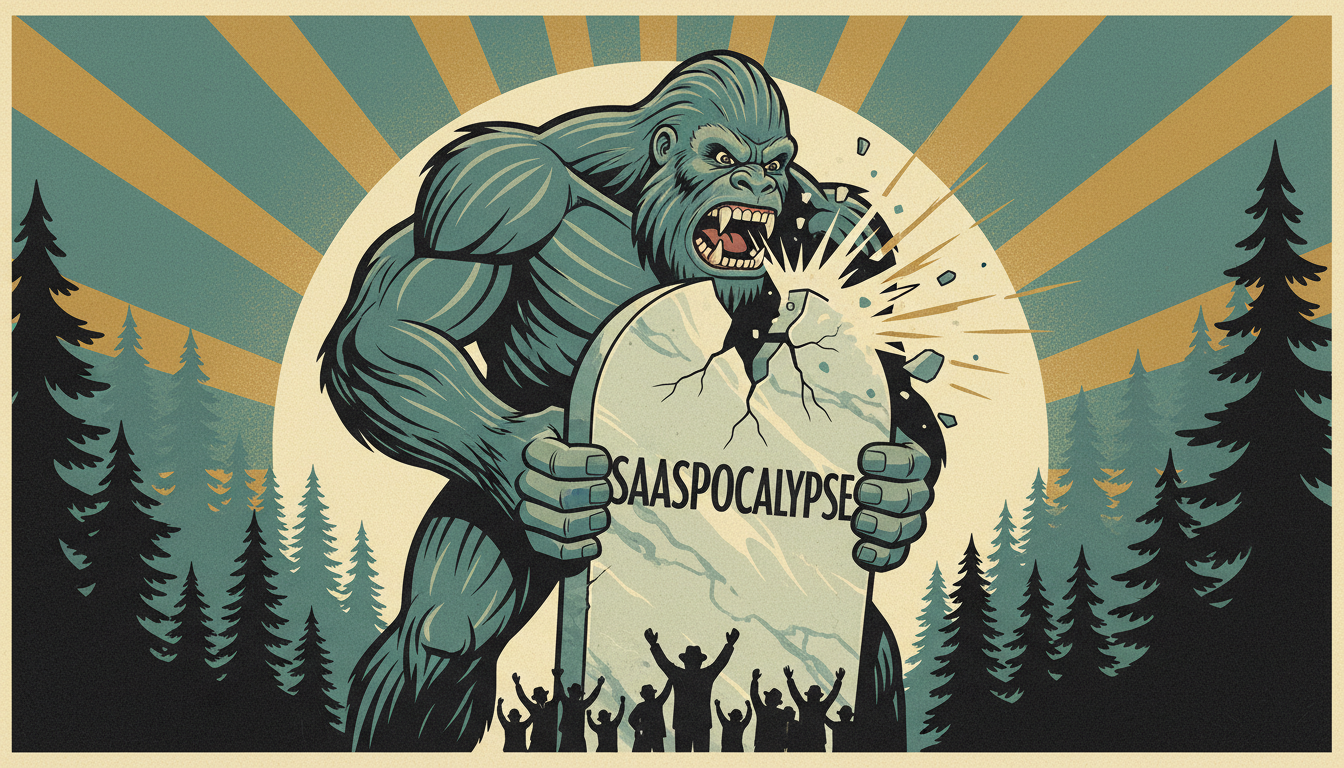
Every week there's another thunderclap of bad news for software companies.
Claude Cowork previews in late January and the sell-off starts. Citrini Research — James van Geelen and Alap Shah — publishes "The 2028 Global Intelligence Crisis" on Substack in late February and another trillion dollars of software market cap gets flushed. Claude Managed Agents launches on April 8: Akamai -16.6%, Cloudflare -13.5%, DigitalOcean -13.4% the same day, $285 billion across the sector. Then Mythos leaks and the software companies responsible for cyber-security get hit hard.
Since January, $2 trillion of software market cap has been erased.
The analysts' thesis: AI is so powerful everyone will just need AI and all other software is irrelevant. Or....ACK it's a SaaSpocalypse! Software is dead!
Benioff's response: My SaaSquatch will eat your SaaSpocalypse. Long live software!
Let's stop and figure out what's happening here.
Meanwhile...free cashflow is flowing
Over the three-year window these stocks cratered, the actual businesses grew. Here's the decouple:
| Company | Stock 3yr | Revenue 3yr | FCF 3yr | P/FCF |
|---|---|---|---|---|
| Adobe (ADBE) | -37% | +22% | +42% | 25x → 10x |
| Salesforce (CRM) | -12% | +32% | +128% | 30x → 11x |
| Atlassian (TEAM) | -60% | +48% | +68% | 52x → 13x |
| HubSpot (HUBS) | -49% | +81% | +200% | 110x → 19x |
| Intuit (INTU) | ~flat | +40% | +42% | 40x → 18x |
Start with Adobe — the company the analysts love to bury. Stock down 37% over three years, 66% from its 2021 peak. Record free cash flow of $10.3 billion — an all-time high. Operating margin essentially unchanged from that 2021 stock peak. The market isn't worried about Adobe's fundamentals. It can't find them through the AI panic.
HubSpot is the cleanest magnitude story. Stock down 49%. Revenue up 81%. Free cash flow up 200%. Multiple compressed from 110x to 19x. The stock halved while the business tripled its cash generation.
The common defense is that stock markets are forward-looking and earnings are backward-looking. Fine. But these companies aren't announcing bad news. They're announcing records. The decouple isn't a forecast. It's vibes versus fundamentals.
The hard part isn't the code
"Vibe coding" is quickly becoming the wrong term for what Claude Code is actually capable of. It's not vibes and AI having fun. It's three decades of software-engineering practice executing at machine speed instead of at the speed of a human typing. That's a real step change — bigger than anything in the last twenty years of the craft, and we've only had it for six months.
But writing code faster isn't the hard part anymore.
Knowing why a payroll bug in Q4 costs you three customers and an auditor — that's the hard part. So is knowing why a compliance screening that returns a false negative exposes you to statutory damages nobody priced into the product. Claude Code doesn't know any of that. A human who's lived in the business does.
Point Claude Code at a hard problem with no domain expert steering it and you get plausible-looking software that fails in production. The failure will show up exactly where a domain expert with a decade of experience and deep intuition about the problem set would have told you to look.
AI productivity matters, but so does domain expertise. Over the next decade, productivity gains are nearly guaranteed — the path for developing deep domain expertise is far less clear. The breakthroughs I'm seeing every day are happening where the two meet: humans who've lived inside a specific problem, working with agentic coding to ship products in a fraction of the time. That's real, and it's a massive unlock.
Trust is the moat. Trust is built on domain expertise, not on coding speed.
AI on one side is a feature, not a company
To justify a premium multiple in this market, a company has to show AI doing real work on both sides of the ledger — not one.
Externally — customers feel it. The product is measurably smarter, faster, or more capable because of AI. Not a "powered by AI" sticker. Actual leverage they can't get from a cheaper tool.
Internally — operations compound. Support is faster. Sales is more targeted. Engineering ships more. Headcount stays flat while profits expand.
External-only is a feature bolt-on. Internal-only is a cost story. Both is a flywheel.
Ramp, the business card and expenses software company, is running an incredible AI playbook that's a model for all of us operators and investors. On the customer side, their Agents product reviews 100,000 expenses a day at 99% accuracy and catches 15x more out-of-policy spend than non-AI alternatives. Customers have saved $10 billion in aggregate. In the last four months, 2,500+ businesses connected Ramp to Claude Code or ChatGPT through Ramp's MCP integration — up from 275 at the start of the year. That's not "we added AI." That's customers paying for the outcome the AI produces.
On the internal side, 99.5% of Ramp employees use AI weekly. 84% use coding agents — including the non-engineers. Half the code at the company is written by AI. In six weeks, 800 employees built 1,500 internal apps. Underwriting response time dropped from two days to four hours.
The scoreboard: in 2025, Ramp raised $500 million at a $32 billion valuation — up from $22.5 billion. During the SaaSpocalypse. The market is pricing them like it's 2021 because their product and their operations are both getting compounded by AI. That's what the premium looks like.
Salesforce is the pure-play public-market version of the same playbook. Agentforce is live with 23,000 of their 150,000 customers. Last quarter the platform handled 2.4 billion agentic work units — up 57% sequentially. Operating income is up 700% over three years. Free cash flow up 128%. Benioff put it on the Q4 FY26 earnings call in February:
"If there is a SaaSpocalypse, it may be eaten by the Sasquatch because there are a lot of companies using a lot of SaaS and it just got better."
He's not defending SaaS in the abstract. He's defending the SFDC numbers that prove it.
Every CEO must articulate both sides of their AI story in plain English in under 30 seconds.
The moat is the domain, not the model
AI is probabilistic. A lot of business problems don't want probabilistic. They want a right answer, every time, with a paper trail.
Tax filings. Payroll. Compliance screenings. Regulated healthcare workflows. Billing reconciliation. Security audits. The software that throws alarms when something's wrong and costs the business real money when it's late.
That's where deep expertise drives premium valuation, and it's where AI is an accelerant to the moat, not a threat. When the bar for "I can generate an app" drops, the bar for "this software can be trusted with a regulated workflow" goes up. Good software gets commoditized. Correct software gets rarer and more valuable.
Mark Miller is the new president of Constellation Software — the best software acquirer in the world. On the Q4 2025 earnings call, he said this:
"Building products faster will not differentiate us long term. It will become table stakes. What will matter is what our businesses have spent many years developing — deep vertical knowledge, a genuine understanding of customer workflows, and the trusted relationships they've built."
Read it again. That's the whole section in one paragraph, said by a man who buys software for a living.
Adobe isn't selling image generation. It's selling the workflow from a concept to a shipped campaign — approvals, brand checks, version control, print specs, license tracking, all of it. Nano Banana wins you some productivity points in the early iteration steps. It doesn't touch the rest.
Intuit isn't selling "AI accounting." It's selling the tax return your CPA can sign, that the IRS will accept, that your CFO will swear to. Deterministic by design, with AI layered on for insights and pattern matching. That's exactly where AI should live in a regulated workflow.
The combination that earns a premium multiple in 2026: great UX, deep domain knowledge, deterministic data processing, and AI as the amplifier — insights, agentic handling of the routine (Ramp's 100,000 expense reviews a day), and accessibility through open protocols like MCP. Everything else is fighting for survival.
How I size up a software company now
When I look at a software company, I want to see three things. Missing any one is a clear path to valuation reduction.
- A difficult problem that requires deep expertise. If a smart person can understand the domain in a weekend, so can an AI. If the domain takes decades to master, it has a moat.
- A credible AI strategy on both fronts. External leverage for customers. Internal leverage for operations. Without both, the company doesn't clear the bar for a premium multiple.
- A distribution model that survives next week. If someone can clone the product in a sprint and steal the customers through cheaper ads, there's no company. There's a feature with a distribution problem.
Apply it to the names in the decouple table. Adobe: hard problem, AI strategy taking shape across Firefly and enterprise, distribution moat through enterprise contracts and forty years of creative-team habits. Clean pass. Salesforce: hard problem, strong external AI in Agentforce, internal redeployment less clear. Call it a partial pass — and the multiple reflects the mixed picture.
The companies that won't make it are the ones that fail on the test. I recently met someone at a big public software company who was excited because he'd figured out how to use AI to write performance reviews for his team in Slackbot. Saves him ten minutes. Meanwhile Ramp is shipping four or five years of product per quarter. Those signals tell you who wins the next decade.
Others will fail for reasons specific to this moment. Thin wrappers whose customers can churn to a vendor that ships the same feature in a weekend. Seat-based pricing on a product where the seat is actually about to disappear. Category copycats with no deep domain (looking at you Allbirds, ahem, NewbirdAI).
Don't trust Wall Street analysts to tell you what software is dead. A lot of smart people are overreacting to a business model they don't understand.
The operators are buying what the analysts are telling you to sell
The smart money is not panicking.
Constellation Software — Canadian, publicly traded as CSU, the best software acquirer in the world — did the following in fiscal year 2025: deployed $1.579 billion across more than 120 acquisitions, another $530 million in minority stakes, and already committed $802 million for 2026 as of March. Their own stock is down roughly 50% over twelve months. And they accelerated their buying.
Their CFO, on the record: "We believe there are ample opportunities to deploy capital as opposed to buying back our own shares." Translation: the returns we can get buying other people's software are better than buying our own stock at a 50% discount.
Their CIO, Bernie Anzarouth, on the Q4 2025 earnings call — this is the whole article in one line:
"We haven't really seen on the private side any change in pricing so far."
Public has capitulated. Private has not. The people who buy software businesses for a living look at the same haircut on ADBE and CRM and HUBS that retail sees — and they conclude that the public valuation is the broken one, not the private one.
They put a structural bet behind it. CSU's new PEMS strategy — Permanent Engaged Minority Shareholder — targets public software companies whose stocks have been wrecked but whose businesses are fine. First deployment: 12.7% of Sabre for $86.2 million, implying roughly a $680 million market cap for a travel-software incumbent that once traded in the multi-billions. A public software cadaver, picked up at a fire-sale price by the savviest buyer in the category. Not because Sabre is getting saved. Because Sabre is getting bought right.
If the best software acquirer in the world is deploying capital faster than ever while retail dumps the same names, one of them is wrong about whether software is dead.
Nano Banana didn't kill Adobe. The analysts did.
Nano Banana is cool. I mean it. A text prompt into a photo-realistic image would've been science fiction five years ago, and it's a toy today.
But it's a tool. Tools democratize the entry point. They don't eliminate the workflow.
When anyone in your company can generate a clever image or video, more teams will need the system that turns all that output into something the business can actually use — a brand, a shipped product, a regulated ad that doesn't get you sued. Adobe has spent forty years building that system. A better image generator makes those workflows more necessary, not less.
The analysts are reading the press release. The operators are reading the business.